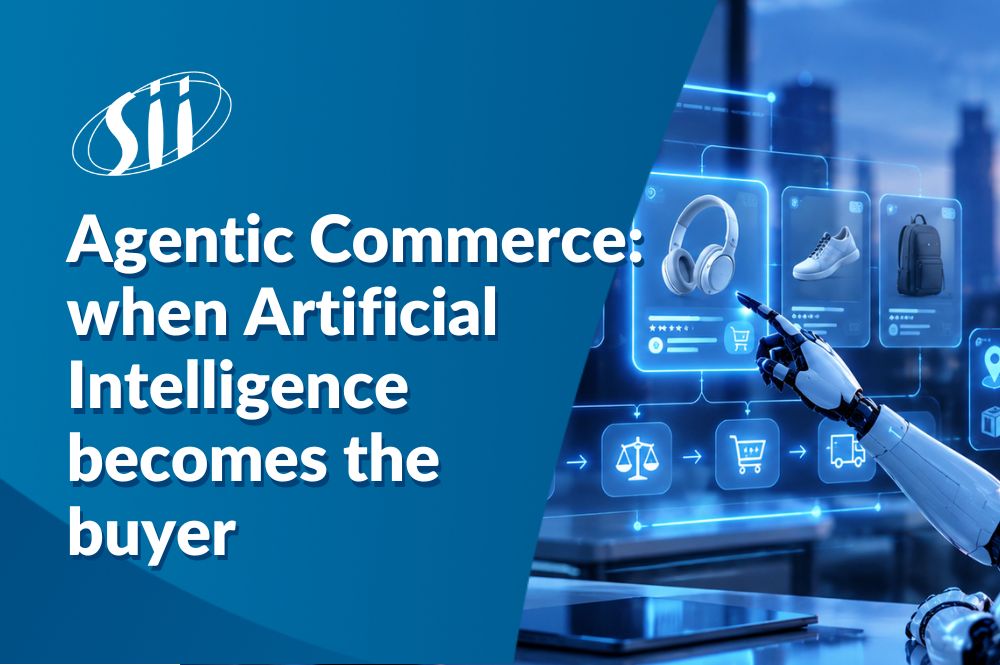
For years, e-commerce has tried to shrink the distance between discovering a product and buying it. First came search engines, then personalized recommendations and, more recently, conversational assistants. The next step changes something deeper: an artificial intelligence that not only helps us decide what to buy, but can also carry out the purchase on our behalf. Agentic Commerce thus raises a new relationship between consumers, brands, and digital platforms, where the interface no longer has to be a store but can become an agent capable of interpreting goals, comparing options, and taking action.
From click to intent
Traditional e-commerce is built around a fairly familiar sequence: search, compare, add to cart, enter payment details, and confirm.
Agentic commerce introduces a different logic. The user can express an intent — for example, finding headphones for work, within a certain budget and with specific features — and delegate much of the subsequent process to an artificial intelligence agent.
The difference lies not only in the conversation. An agent can interpret context, look up information, compare alternatives, and, depending on the level of autonomy allowed, complete certain actions.
This evolution is starting to take shape in concrete initiatives. In 2026, major tech and financial players are working on protocols and standards designed to make it easier for agents, merchants, and payment providers to communicate in an interoperable way. Google, for example, has driven the Universal Commerce Protocol to connect agents with commerce systems throughout the purchasing process.
The underlying goal is simple to understand: to allow artificial intelligence to operate within the commercial ecosystem without having to rebuild every interaction from scratch.
The new interface doesn't have to be a store
The change may seem subtle, but its implications for e-commerce are significant.
Until now, a brand competed to attract users to its website or app. The experience was designed for people to browse categories, filters, recommendations, and product pages.
With AI agents, part of that browsing can disappear.
Consumers might not visit ten stores to compare ten products. They could delegate that task to an agent that checks different sources and returns a reasoned selection.
This shifts the center of gravity of e-commerce: the webpage no longer has to be the starting point of the commercial relationship.
And a new question arises for brands: how does a product gain visibility when the one deciding what to show is not directly a person, but an artificial intelligence system?
The answer, among other things, comes down to the quality and structure of the data. Catalogs, availability, prices, features, delivery conditions, return policies, and reputation must be correctly interpretable by systems that don't read a store exactly the way a person does.
The product needs to be understandable both to the consumer and to the machines that mediate its discovery.
The real challenge: trusting whoever acts on our behalf
Autonomy raises an issue that goes beyond user experience: trust.
Buying on someone else's behalf requires knowing what the agent can do, how far its authorization extends, and what happens when something goes wrong.
In April 2026, the FIDO Alliance announced the creation of a dedicated working group on agent authentication and the development of frameworks for agent-initiated commercial interactions. The initiative stems precisely from one reality: traditional authentication mechanisms were designed for human users, not for systems acting on someone else's behalf.
That is why the future of Agentic Commerce will not depend solely on agents being able to buy. It will also depend on their ability to prove who they are, on whose behalf they are acting, and what they are authorized to do.
Granular authorization plays a fundamental role here. Allowing an agent to search for a product is not the same as allowing it to make a purchase of 50 euros, 500, or 5,000.
Spending limits, authentication, human approval, specific credentials, or reversal mechanisms will become increasingly important elements in this new architecture.
From requirements to emergent behavior
Another challenge is validation.
In a conventional system, we can check whether a function meets a given requirement. In an SoS, some of the most important capabilities do not belong to a single component.
An intelligent transportation system can combine connected vehicles, traffic lights, urban sensors, control centers, navigation systems, and data platforms. None of them, on its own, provides intelligent mobility.
The capability emerges from the interaction.
This means testing must also evolve. It is no longer enough to verify components in isolation. It is necessary to analyze scenarios, collective behaviors, edge conditions, and possible changes during operation.
The specialized literature notes precisely that Systems of Systems require recurring adaptation during operation due to the uncertainty and variability of the environment.
From catalog to agent-ready infrastructure
This change also affects companies' technological architecture.
An e-commerce business prepared for this scenario needs more than a good interface. Catalog, inventory, pricing, promotions, order, payment, and after-sales systems need to be able to expose information and operations in a structured and secure way.
The move toward APIs and protocols specific to agents points precisely in this direction. Some 2026 projects are already proposing technical contracts to create and manage checkout sessions via APIs, keeping the merchant as the system of record for orders, payments, taxes, and compliance.
This introduces an especially relevant idea: Agentic Commerce is not about adding a chatbot to an online store.
It means preparing the digital ecosystem so it can be interpreted and used by new software actors.
In that sense, data quality, interoperability, security, traceability, and the ability to integrate systems take on a weight comparable to that of the user experience itself.
Engineering for systems that will keep changing
Perhaps the main difference compared to other approaches is this: a System of Systems should not be designed assuming it will remain stable.
Its components will evolve. New technologies will appear. Operational requirements will change. Some systems will be replaced and others added.
The architecture must be able to absorb that evolution without losing the overall mission.
That requires thinking about interoperability, modularity, interface evolution, traceability, and resilience from the earliest phases of the life cycle.
Systems Engineering is now defined as a cross-cutting, integrative discipline that accompanies systems from conception through operation and retirement. In a System of Systems, this life-cycle view becomes even more important because the evolution of one component can change the behavior of the whole.
A change of model, not just of channel
It is still too early to know how far this transformation will go. Agentic commerce is at a stage of technological consolidation and standard-setting, and significant barriers still exist around trust, liability, interoperability, and adoption.
But the conceptual shift is already here. For decades, digital commerce has sought to build increasingly simple experiences so a person can buy. Now a different stage is beginning: building infrastructures smart and trustworthy enough for a system to be able to buy according to a person's preferences.
The difference may seem small. From the standpoint of technological architecture, it is not.